ASA

Printed in parts, one solid piece.

ASA, ASA-GF and ASA-CF printed to order. The parts are welded together and sanded smooth instead of leaving a row of fragile seams.

Large work comes in parts, and that is usually where the weak spot sits: a glued or screwed joint is exactly where the piece gives way. ASA does it differently. The parts weld into one solid object, the seam becoming material rather than a layer of glue in between. What you get back behaves as one piece, not as parts hanging together.

On top of that comes the temperature range. ASA holds about 90 C without load and about 90 C under load (the heat deflection temperature from the manufacturer minus a 10 C margin), so it is a good choice for a hot car, a housing next to a heat source or a piece in the sun all day. Tell us the load and the temperature, and we will say whether it fits.
Three grades

All three weld the same way; each has its own stiffness.

ASA

Unfilled and the toughest of the three. Without load about 90 C, under load about 90 C. Choose this for large pieces and covers that may take a knock.

ASA-GF

Glass fibre makes it stiffer, and a little less tough than plain ASA. Without load about 85 C, under load about 80 C. The middle road for brackets and supports.

ASA-CF

The stiffest: without load about 90 C, under load about 85 C. Carbon fibre does make it more brittle, so only when deflection is worse than breakage.

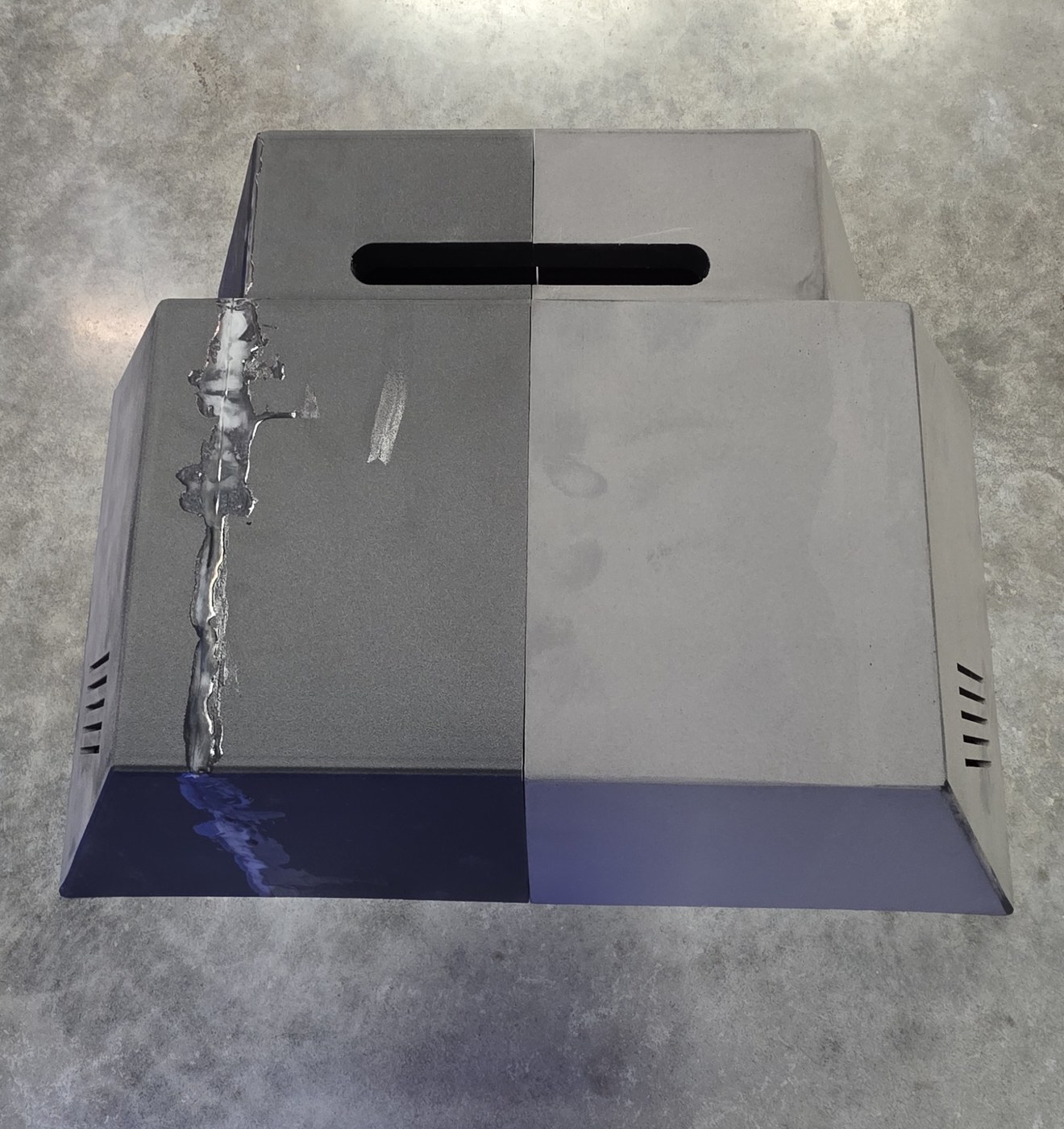
Seen here

Before and after the seam.

Two matching printed housings on the floor, the left one with a raw glue seam still clearly visible, the right one sanded smooth so the seam has almost disappeared.
Two identical printed enclosures side by side: left with the glue seam still visible, right after the seam has been finished away.

Typical work: multi-part housings without a bolt in sight, props and set pieces, assemblies bigger than a printer can do, holders on vehicles, and replacements that crumbled after one summer in ordinary material.

If the part has to take more heat or chemicals than that range, PPA or PPS comes into view. If it has to take heavy wear, look at a fibre reinforced nylon; on wear resistance ASA is the weakest of the range.

And then there is the sun. ASA is made for outdoor use and, in our experience, holds up better than most polymers. Indoors that is a welcome extra; outdoors it is the very reason to choose ASA.

A piece that has to come in parts?

With a 3D file, the quote tool shows your price straight away. Just a photo with dimensions? Email it to info@nworks3d.be and you will hear how we split it and which ASA fits.