What you send me
Send the part in.
Sending the part in is the standard: the real part always measures better than a photo. Let me know through the contact form and state what it is worth. If that does not work, we look at the options.
Reverse engineering in plain words: from a part with no drawing or file to a working 3D model, printed again.
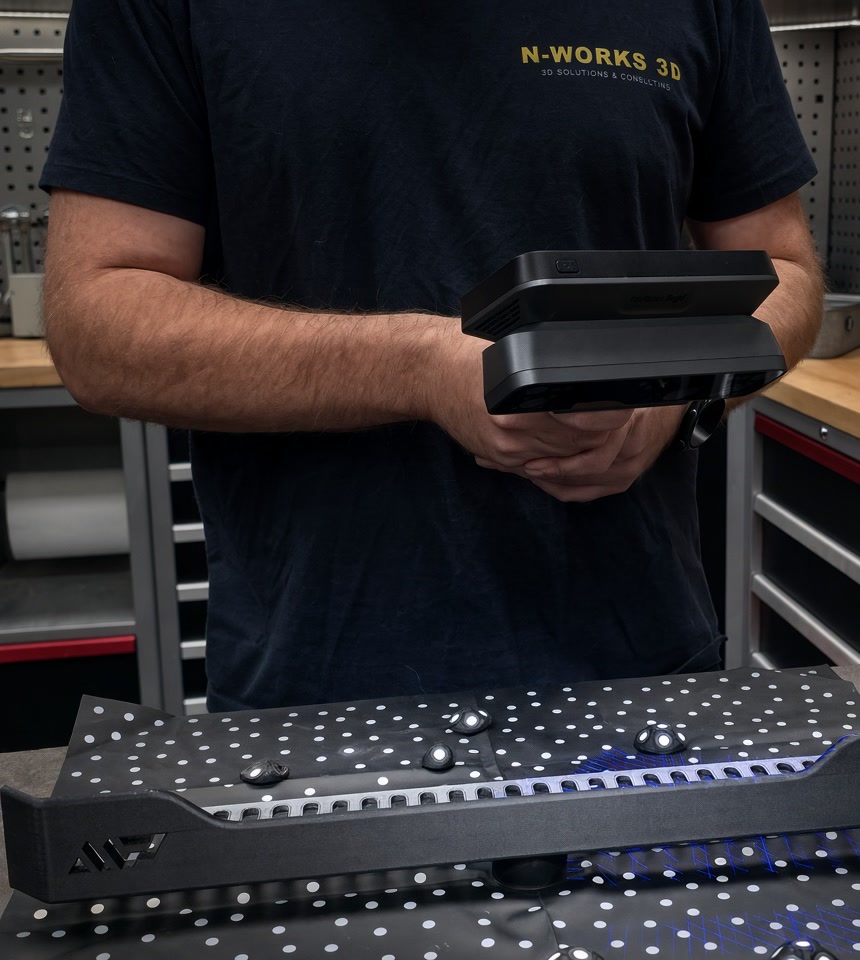
Reverse engineering means making a model again from an existing part. You only have the piece, no drawing and no file. For most parts that break, that is exactly the situation.
This is how it runs: I scan the part in 3D, build a working 3D model with real dimensions from that scan, and print it again in a material that suits what it is used for.
The part is measured from every side, including the sides nobody sees. Broken in two is no problem: I glue the pieces together temporarily and scan them as one.
The scan becomes a properly built model with real dimensions, not a scanned skin. Only then can you still adjust a dimension later or add a reinforcement.
I print the model in a material that suits the job. Where it is allowed, I strengthen the spot where the original gave way.
Shiny, transparent or black surfaces scan badly. A thin matting spray takes care of that and disappears afterwards. What no scanner sees is a deep hole: those dimensions I measure by hand.
Sending the part in is the standard: the real part always measures better than a photo. Let me know through the contact form and state what it is worth. If that does not work, we look at the options.
A part that carries a safety function, is under pressure or has to be certified, I do not print as a replacement. If your file needs a certified measurement or a metrology report, this is the wrong address.
Tell me about your part through the contact form and state what it is worth, and you will hear what is possible.
Go to the contact form